ATO Audit Hotspots for 2026 — what individual taxpayers need to know before 30 June

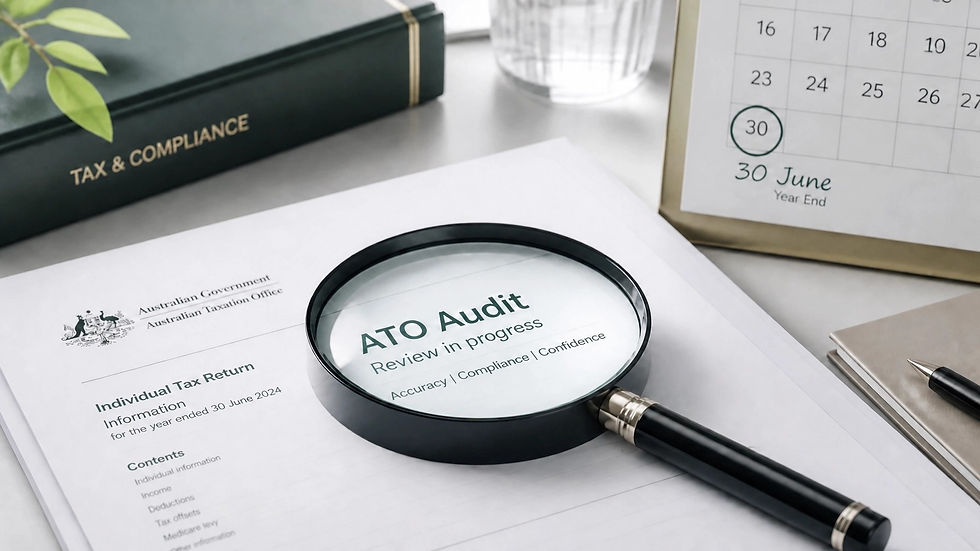
The ATO has received $75.7 million in funding to ramp up compliance activity, and that means one thing for you: significantly higher scrutiny in 2026. If your records are sloppy, your deductions are optimistic, or your paperwork is sitting in the “I’ll deal with it later” pile, this year is not the year to wing it.
1. ATO interest charges are no longer tax-deductible
If you have ever softened the sting of an ATO interest charge by telling yourself, “At least it is deductible,” that comfort is gone. From 1 July 2025, General Interest Charge (GIC) and Shortfall Interest Charge (SIC) imposed by the ATO are no longer tax-deductible for individuals.
That means late payment now hurts twice. You pay the interest, and you lose the tax deduction that used to take a bit of the edge off.
Why the ATO interest change matters
Non-deductible from 1 July 2025:GIC and SIC imposed by the ATO are no longer deductible for individuals from 1 July 2025.
Late payment costs more: There is no deduction for interest on unpaid income tax, GST, or amended assessments.
Remissions are tax-free: If the ATO later remits a non-deductible SIC or GIC, the remission is not assessable income.
Personal loans are not a loophole: Interest on personal loans used to pay income tax is also not deductible for employees and passive investors.
How to protect yourself
Lodge on time: This is still the cheapest tax strategy ever invented.
Pay on time where possible: A late payment is now a straight cash-flow hit with no tax upside.
Ask about GIC-free payment plans: Eligible small businesses may be able to access GIC-free payment plans, which is far better than funding the ATO’s coffee budget.
Request remissions where appropriate: If interest has already been charged, ask whether a remission request is available based on your circumstances.
2. Car logbook claims are under heavy ATO scrutiny
Car logbook claims are under heavy ATO scrutiny in 2026, and recent Tribunal decisions have not exactly gone well for taxpayers. If your records are vague, reconstructed, inconsistent, or overly convenient, the ATO will not be happy to allow the claim. In short, “close enough” is no longer close enough. If your logbook says “Client visit”, the ATO wants to know which client, where, and why.
What the ATO is targeting
Vague descriptions: Entries like “Client visit”, “Business trip”, or “Customer meeting” are too generic. The ATO wants specifics such as “Client visit, Essendon” or a clear business purpose and location.
Reconstructed logbooks: If you are rebuilding a 12-week logbook from memory, calendar scraps, or map history months later, that is a problem.
Unchanged 5-year-old logbooks: A logbook can remain valid, but your business-use percentage still needs to reflect your current reality. If your work pattern has changed, your old logbook may be stale.
The "busiest 12 weeks" trick: Recording only your most travel-heavy period to inflate your claim is exactly the sort of thing that gets noticed.
Inconsistencies: If your kilometres, work pattern, diary notes, and other records do not line up, the ATO will assume the logbook is unreliable.
How to protect your car claim
Keep a continuous 12-week logbook: It should cover a genuine and representative period.
Record the right details: Include the day, odometer readings, kilometres travelled, and the specific business purpose for each trip.
Capture year-end readings: Record your odometer at the start and end of the financial year.
Refresh when your work changes: If your role, location, or travel pattern shifts, start a fresh logbook. This is basic hygiene in small business accounting Australia, not an optional extra.
3. Rental property interest - the redraw trap
Rental property interest deductions remain one of the ATO’s favourite hunting grounds. The numbers are large, the mistakes are common, and many taxpayers still assume that if a loan is secured against an investment property, the interest must be deductible. Sadly, tax law is not that sentimental.
The ATO is looking closely at how borrowed funds are actually used, not just what property sits behind the loan.
What the ATO is targeting
Redraw facility traps: If you redraw from an investment loan for private spending, that portion of the interest becomes non-deductible.
Mixed-purpose loan apportionment: Once private use enters the picture, the loan becomes mixed-purpose and the interest must be apportioned carefully.
Vacant land rules: Interest on loans relating to vacant land may not be deductible unless the relevant conditions are satisfied.
Joint loans for solely-owned properties: If a property is owned by one person but the loan is in joint names, the deduction position can become messy without written agreements and clear evidence.
How to protect your rental deductions
Avoid redraw for private spending: This is the big one. Mixing private use into an investment loan creates long-term pain.
Use separate sub-accounts: If funds are borrowed for different purposes, keep them structurally separate.
Keep clear records: If the ATO asks where the money went, you want documents, not interpretive dance.
4. Super Contributions (Don't forget your notice of intent)
Personal super contribution deductions are still one of the best legitimate tax moves available, but they come with paperwork rules that are brutally strict. Tribunal decisions show that if the notice rules are missed, the deduction is gone. No discretion. No sympathy. No magical “but I meant to” exception.
To claim the deduction, you must lodge a valid Notice of Intent to Claim with your fund and receive written acknowledgement in time.
What the ATO is targeting
Late notices: If the notice is lodged after the deadline, the deduction fails.
No fund acknowledgement: You cannot claim the deduction until your super fund has provided written acknowledgement.
Creating a tax loss: Personal super contribution deductions can also run into trouble if the claim would create or add to a tax loss.
How to protect your super deduction
Lodge early: Do not leave the notice until tax return time.
Wait for written acknowledgement: Keep the acknowledgement from your fund before claiming anything.
Do not start a pension or withdraw funds too early: Wait until the notice has been properly acknowledged.
Get the timing right: This is a simple area to get wrong and a frustrating one to fix, which is why many clients use our tax compliance services to keep everything clean and audit-ready.
Conclusion: Book your 2026 pre-EOFY review before the ATO books you in first
The ATO’s compliance funding boost is a very polite way of saying more reviews, more questions, and less tolerance for weak records. If you want to protect your deductions and avoid nasty surprises, now is the time to tighten up your documentation, review your claims, and fix any weak spots before 30 June.
At Stammm Advisory, we help individuals and business owners stay ahead with practical advice, sharp record-keeping, and the kind of tax savings for Australian businesses that come from getting the details right. Whether you need help with deductions, structures, or small business accounting in Australia, we make sure your position is clear, compliant, and defensible.
Ready to stay audit-ready? Book your 2026 pre-EOFY review with Stammm Advisory today.
Disclaimer: This article is general in nature and does not take into account your personal circumstances. Tax laws are complex and subject to change. Please contact the team at Save Tax and Make More Money before acting on any of the information above. Based on ATO compliance guidance published May/June 2026.
Comments